Our impact
The Modern Cooking Facility for Africa aims to provide over 4 million Africans with access to clean cooking solutions by 2028.
The Modern Cooking Facility for Africa aims to provide over 4 million Africans with access to clean cooking solutions by 2028.
Lack of access to clean cooking solutions remains a global challenge. Clean cooking is is one of the key sectors contributing to accelerating the green energy transition in Africa. Around 2.1 billion people worldwide lack access to clean cooking, almost 1 billion of whom live in Sub‑Saharan Africa. In most project countries, access to clean cooking remains below 20%.

portfolio companies

Clean Cooking Services sold

people with access to clean cooking

Committed funding:

Disbursed:

Leveraged co-financing:
of CO2 emissions avoided per year

of unsustainable wood harvest avoided per year

Averted mortality and disability-adjusted life-years
MCFA’s impact management ensures transparent and evidence-based measurement of how clean cooking services (CCS) improve wellbeing, reduce emissions and support sustainable market development across its project countries. This approach supports accountability and generates learnings that benefit both programme steering and sector development.
MCFA specifically focuses on higher-tier clean cookstoves, a market segment that remains challenging due to a lack of financing, limited consumer awareness, weak infrastructure hindering distribution networks and the need for reliable energy access. MCFA aims to increase the availability and affordability of these cooking solutions through financial incentives, enabling companies to leverage additional financing, including carbon finance, and by specifically supporting PAYGO and consumer‑finance models.
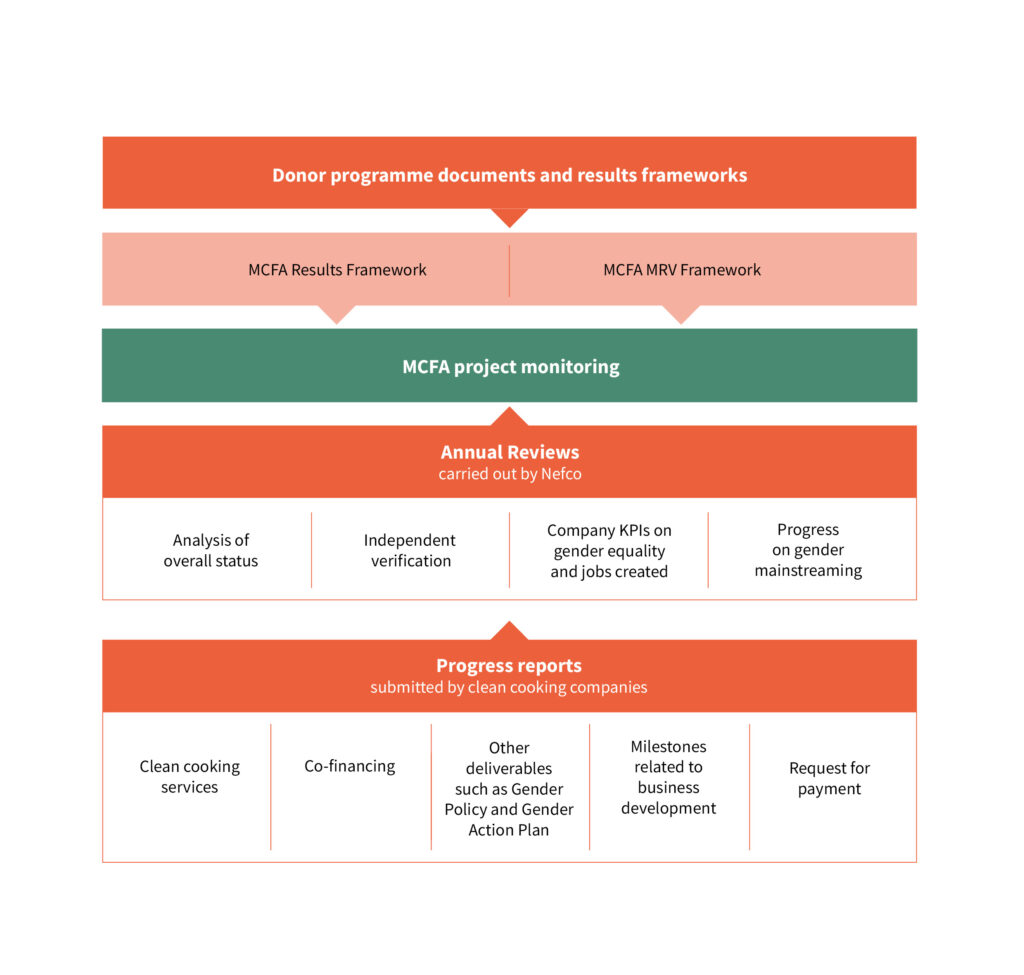
MCFA also supports integrated tool and fuel delivery models, ensuring sustainable fuel is readily available and more affordable than traditional alternatives, such as charcoal. The key outcome of the programme is increased and sustained use of clean cooking solutions and fuels. This transition improves health and well-being – particularly for women and girls – by reducing exposure to harmful pollutants.
Additionally, it reduces greenhouse gas emissions, mitigates deforestation and biodiversity loss, and frees up time for women and girls by reducing the burden of fuel collection and cooking. At the same time, new jobs are created and gender equality is strengthened within the clean cooking companies and their business operations.
The programme also generates valuable knowledge and data on sectoral challenges and opportunities from the perspective of private companies while mobilising additional funding for the clean cooking market. These efforts contribute to the broader adoption of sustainable cooking solutions among residential, commercial and institutional users. Through these mechanisms, MCFA drives systemic change, fostering a more advanced, sustainable, inclusive and resilient clean cooking sector in Sub-Saharan Africa.
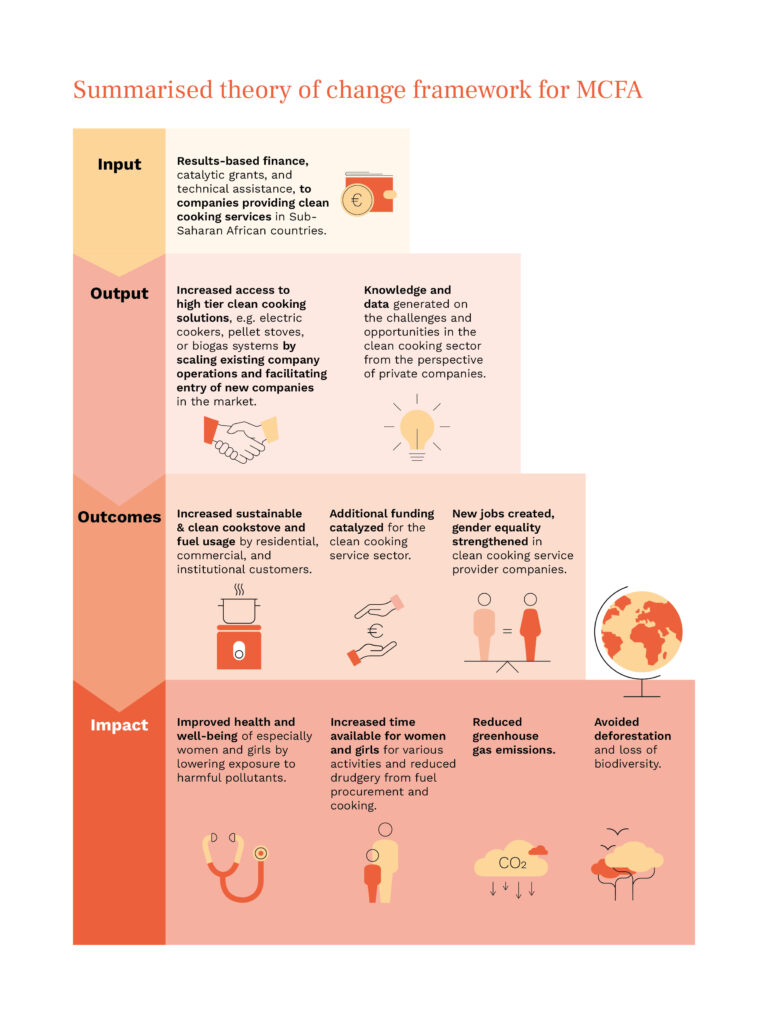
The MCFA Monitoring, Reporting & Verification (MRV) Framework outlines the principles and processes for monitoring project progress, releasing results-based finance to clean cooking companies, and verifying the accuracy of payment requests.
At its core are project progress reports, submitted to Nefco as Facility Manager, after companies sell clean cooking services. These reports include customer payment details (such as dates and amounts) for each client, allowing us to monitor ongoing payments by end-users. This payment tracking acts as a proxy for sustainability, confirming that customers continue to use the stoves as intended.
Progress reports also include information on potential co-financing leveraged by the company. Companies report annually on gender indicators and potential jobs created as a result of MCFA support.
An independent verification agent (IVA) is engaged to verify the delivery of clean cooking services through telephone surveys and, when necessary, site visits. Additionally, all companies are gradually being integrated to Prospect, a software platform that allows sales data required for results reporting to be pulled directly from companies’ customer relationship management systems. The IVA, composed of a consortium formed by NIRAS International Consulting and 60 Decibels, also investigates the availability of fuel for clients, when relevant, as this is a critical requirement of the MCFA.
Based on the clean cooking services delivered, Nefco estimates additional social and environmental benefits generated as co-benefits. These include:
In addition, companies report:
Overall, impact considerations and compliance with Nefco’s policy requirements are closely intertwined and integrated throughout the project cycle – from determining guidelines for calls for proposals, evaluating proposals, conducting due diligence and contracting to the monitoring, verification and evaluation of results – ensuring the delivery of sustainable social and environmental impacts.
MCFA’s climate, health, and environmental impact indicators are calculated using the MCFA‑adapted version of the WHO BAR‑HAP / CCEC tool. This model translates the number of clean cooking systems (CCS) reported as in use by MCFA investees into quantified impacts for each calendar year. The tool estimates “equivalent stove‑years” based on milestone sales data and applies country‑specific health, emissions, and biomass parameters to generate results for avoided CO₂e emissions, unsustainable wood harvest avoided, and averted mortality and disability‑adjusted life‑years (ADALYs).
For a complete list of assumptions and methodological details used in our calculations, please contact mcfa@nefco.int.
MCFA offers results-based financing (RBF) focused on incentivising companies in high-risk markets: companies receive payments once they deliver products or services to clients. The RBF is combined with non-reimbursable catalytic grant financing and technical assistance (TA). The aim of MCFA funding is to function as a bridge between seed funding and carbon finance or commercial loans/equity.
To receive MCFA funding, investees must provide affordable, high-quality clean cooking services (CCS) directly to consumers, ensuring long-term sustainability. The CCS can be provided with a variety of modern, higher-tier cookstoves powered by electricity, biogas, LPG, solid or liquid biofuels or solar energy. In addition, to ensure usage and adoption, investees are also required to sell and make relevant fuel available to their customers, either directly or through a partnership. Stoves intended to be used with charcoal or wood fuel are not eligible for MCFA funding.
Business models incorporating pay as-you-go (PAYGO) or other consumer finance approaches to increase consumer affordability, stove-use monitoring to support access to high-integrity carbon credits or integrated ‘tool and fuel’ models are strongly favoured by MCFA. MCFA support also extends to energy efficient commercial and institutional cooking services, addressing needs in areas like education and health.
MCFA awards contracts to companies selected through competitive calls for proposals. Business plans are assessed on the technical and commercial feasibility of the proposed clean cooking services, including with regard to fuel supply, financial leverage, management capacity and impact potential. These criteria, combined with the applicant’s financial offer, weighted according to MCFA’s priorities, determine the proposal’s value for money using a reverse auction mechanism, an approach adapted from the Beyond the Grid Fund for Africa (BGFA) Programme. Companies are contracted according to the value for money offered until all available funds are allocated. Two calls for proposals have been conducted since the programme’s launch, both following a two-stage process consisting of Nefco’s own eligibility checks and independent evaluations to ensure integrity of the process.